
What is PWPortal
What is PWPortal?
PWPortal is the client screen for Protocol Wealth — one secure place to see your portfolio context, your onboarding, your documents, your assistant history, your advisor’s recommendations, and a record of the decisions made along the way. It is the client-facing surface ofPWOS, the system our advisory practice runs on.
Most firms ask clients to keep track of their financial life across a custodian login, an email thread, a document folder, and a planning tool that rarely talk to one another. PWPortal brings the pieces a client needs to see into one place, behind one secure sign-in — so the context, the paperwork, the conversation, and the recommendations are in the same room.
PWPortal is where you see your relationship with the firm. PWOS is the system that governs how that work is done, and Protocol Wealth is the registered adviser accountable for it.
In plain terms
What PWPortal is — and is not
What it is
- A secure client portal at pwportal.app, reached with your own sign-in.
- A single view of your portfolio context, onboarding, documents, assistant history, recommendations, and decision records.
- A read-and-review surface — a place to see and discuss, with your advisor in the loop.
- The client-facing surface of PWOS, the firm’s operating system.
What it is not
- Not a custodian — client assets held in custody are at qualified custodians, in accounts in the client’s name.
- Not a trading terminal — you do not place trades or move funds from the portal.
- Not a robo-advisor — recommendations come from your advisor, not from an automated engine acting on its own.
- Not a source of advice from the in-portal assistant — the assistant is informational only.
Inside the portal
What a client sees
Each client sees only their own relationship. The portal is organized around the things a client tends to ask for during a working relationship with an adviser.
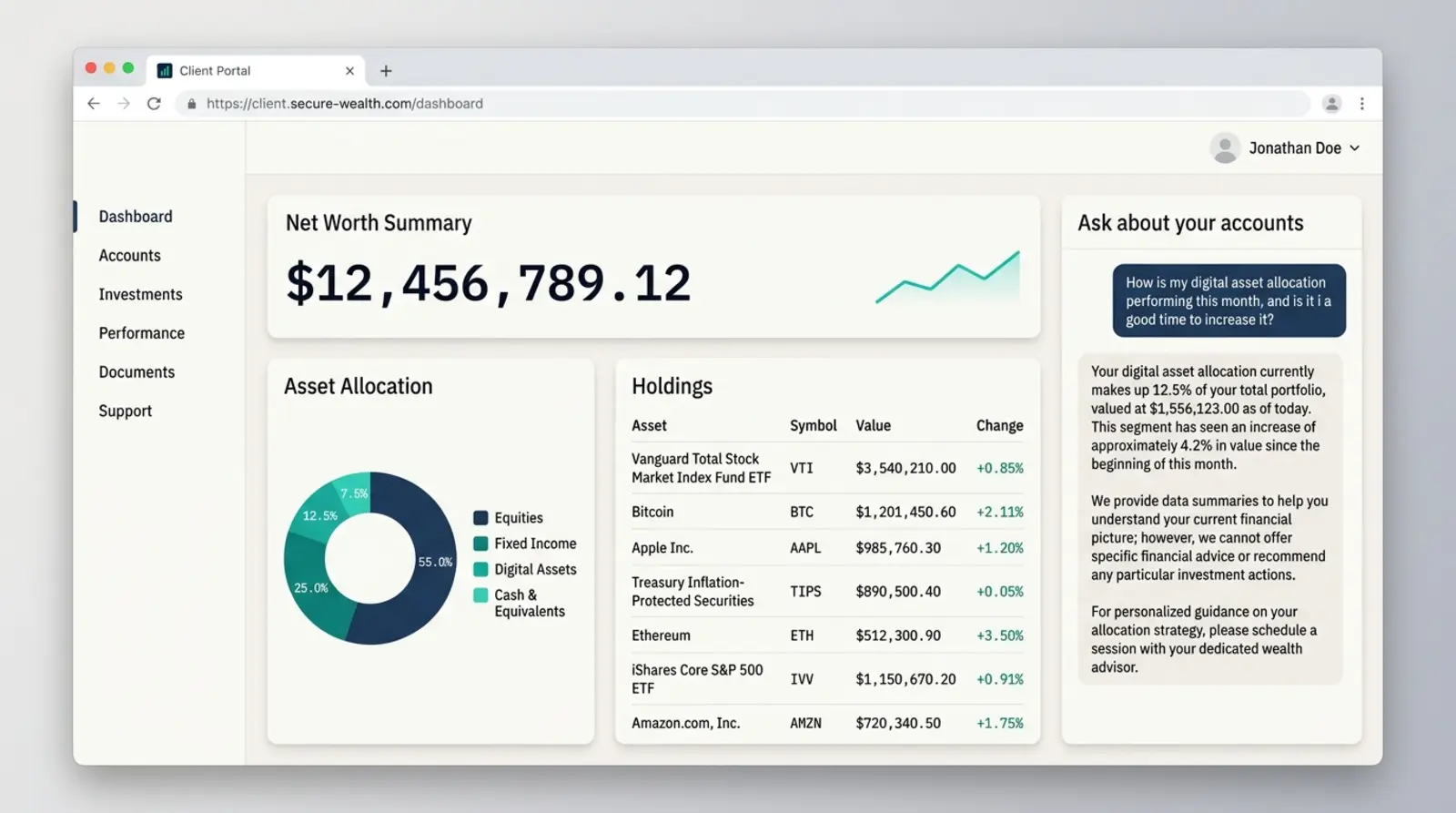
A consolidated view of the accounts and holdings you have connected or shared, brought together so your situation can be seen in one place rather than scattered across logins. Context for the conversation — not a brokerage statement, and not a place to trade.
The steps to become a client — sharing your information, the identity and suitability checks a registered adviser is required to complete, and signing the advisory agreement — handled in one guided flow with a clear view of what is done and what is left. A human at the firm reviews and approves each step.
Your agreements, disclosures, statements, and shared files in one organized place you can return to. Records the firm keeps are retained under its conservative books-and-records posture.
An assistant that helps you find and understand what is already in your portal, with your conversation history saved so you can pick a thread back up. It is designed to help you organize and ask questions; it does not give investment, tax, or legal advice, and it does not act on your accounts. When a question calls for advice, it points you to your advisor. AI assists with organization and understanding; a human fiduciary remains accountable for advice.
The recommendations your advisor has prepared for you, in writing and in one place, with the reasoning attached. Every recommendation a client sees is reviewed and issued by a human advisor who knows your situation — there is no automatic path from a model to a client-facing recommendation.
A record of the decisions made over the course of the relationship — what was recommended, what was discussed, and what was agreed. Designed to support the firm’s books-and-records workflows and compliance review, so the history of the relationship is documented rather than left to memory.
How it fits
How PWPortal relates to the firm and to PWOS
There are three things worth keeping straight, because each one is accountable in a different way:
Protocol Wealth
The SEC-registered investment adviser (CRD #335298) — the accountable entity. The firm provides advice under a signed advisory agreement, and a human fiduciary at the firm is responsible for everything a client sees.
PWOS
The Protocol Wealth Operating System — the in-house system the advisory practice runs on. It governs how AI is used: advisers review advice and client communications before they reach a client. Three things reach a client without that review, all disclosed: answers from the client portal AI Assistant, a limited beta that gives no investment, tax or financial advice; values read from statements and K-1s for outside investments, which are labeled “Unverified” until an adviser confirms or corrects them; and AI Suggestions, labels for a client’s own bank transactions (and rules that apply a label to similar transactions) that AI suggests only if the client turns the feature on, and that change nothing until the client confirms them.
PWPortal
The client-facing surface that runs on PWOS — what you sign into to see your relationship with the firm. The advisor workspace runs on the same operating system; PWPortal is the client side of it.
One way to hold it: PWPortal is the window, PWOS is the structure behind it, and the firm is the fiduciary accountable for both.
Security and trust
How your information is handled
PWPortal is built on the same posture as the rest of PWOS. A few points clients ask about most:
- Not a custodian. Client assets held in custody are at qualified custodians, in accounts in the client’s name. The portal is a place to see and discuss your situation.
- Your data is your data. Each client sees only their own relationship; one client’s information is kept separate from another’s. Your sign-in is your own.
- The assistant does not give advice. The in-portal assistant helps you organize and understand; it does not provide investment, tax, or legal advice and does not act on your accounts. Advice comes from your advisor.
- A record is kept. The firm’s records are retained under its conservative books-and-records posture.
More on the firm’s overall security posture is at/security; the principles behind how we use AI are at our AI Principles; and the firm’s trust surfaces are gathered atthe Trust Center.
This is a description of how we operate. It is not a performance claim, a guarantee of any outcome, or a comparison to any other firm.
See for yourself
Where to look
Client sign-in →
The portal itself, at pwportal.app — for existing clients.
What is PWOS? →
The operating system PWPortal runs on.
Security →
The posture behind how your information is handled.
AI Principles →
How we use AI — humans decide, AI assists.
Trust Center →
The firm’s trust surfaces in one place.
Privacy →
How client information is collected, used, and protected.
Last updated: October 22, 2026. Protocol Wealth, LLC is an SEC-registered investment adviser (CRD #335298). See ourForm ADVfor authoritative regulatory disclosures. Registration does not imply a particular level of skill or training; advisory services are provided only under a signed advisory agreement.
This page describes how Protocol Wealth operates the client portal. It is general information, not a performance claim, a guarantee of any outcome, or a comparison to any other firm, and it is not investment, tax, or legal advice. The in-portal assistant is informational only and does not provide advice. Descriptions of how data is handled describe the firm’s current practice.
All investments involve risk, including the potential loss of principal. Past performance does not guarantee future results.